Subterranean termite defense in the South Carolina Lowcountry requires continuous barriers rather than simple surface applications. Native Eastern subterranean termites and aggressive Formosan subterranean colonies…
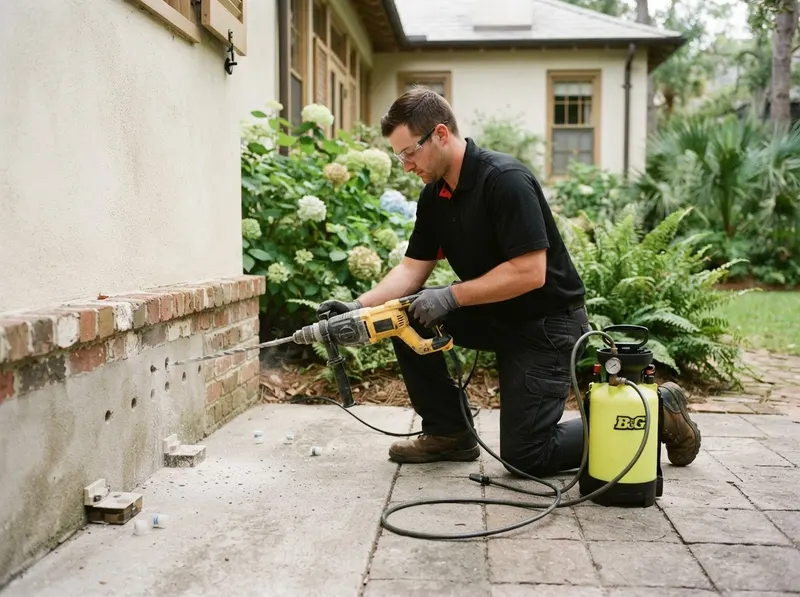
Subterranean termite defense in the South Carolina Lowcountry requires continuous barriers rather than simple surface applications. Native Eastern subterranean termites and aggressive Formosan subterranean colonies live beneath the soil line, tracking moisture into floor joists, sill plates, and subflooring. In historic districts like South of Broad, Harleston Village, and Radcliffeborough, structures rest on soft brick piers with lime mortar, allowing worker termites to construct sheltered mud tubes unseen behind foundation latticework. Ground-level homes on concrete slabs across West Ashley and James Island present different entry points, where plumbing penetrations through the slab expand slightly during humid summers, giving workers direct access into stud walls.
A complete prevention program pairs liquid termiticide barriers with baiting arrays. Liquid applications require excavating a continuous 6-inch trench into the soil along foundation stems and interior pier lines, saturating backfilled dirt at 4 gallons per 10 linear feet. In neighborhoods with high water tables such as Wagener Terrace and Hampton Park Terrace, non-repellent fipronil formulations bind tightly to organic coastal soil without washing out during routine king-tide street flooding. Bait stations spaced every 10 to 15 feet around building perimeters intercept subterranean foraging parties before workers contact structural framing. If structural timbers show existing infestation, localized non-repellent applications stop active feeding within 60 to 90 days.
Moisture control remains the vital non-chemical step for long-term termite suppression. Crawlspace relative humidity exceeding 70 percent along Daniel Island marshes softens heart-pine sills and yellow pine subflooring, speeding wood decay and inviting secondary termite nesting. Replacing torn 6-mil poly ground covers, clearing earth-to-wood soil contacts around deck posts, and inspecting crawlspace masonry ensure the chemical treatments maintain their full 5-to-10-year protective integrity. While hardware store aerosol sprays kill visible swarming termites, they trigger colony budding; true elimination depends on slow-acting chemistry that worker termites carry back to eliminate subterranean queens.
Every job gets a firm, written price after a free on-site visit.
Tell us about your subterranean termite treatment and prevention job in Charleston and we'll send a clear, written quote, usually the same day.
 Coastal Wren Pest Control