Coastal foundation framing in Charleston County faces relentless ambient humidity, with outdoor dew points routinely exceeding 70 degrees Fahrenheit from April through October. In neighborhoods with historic raised…
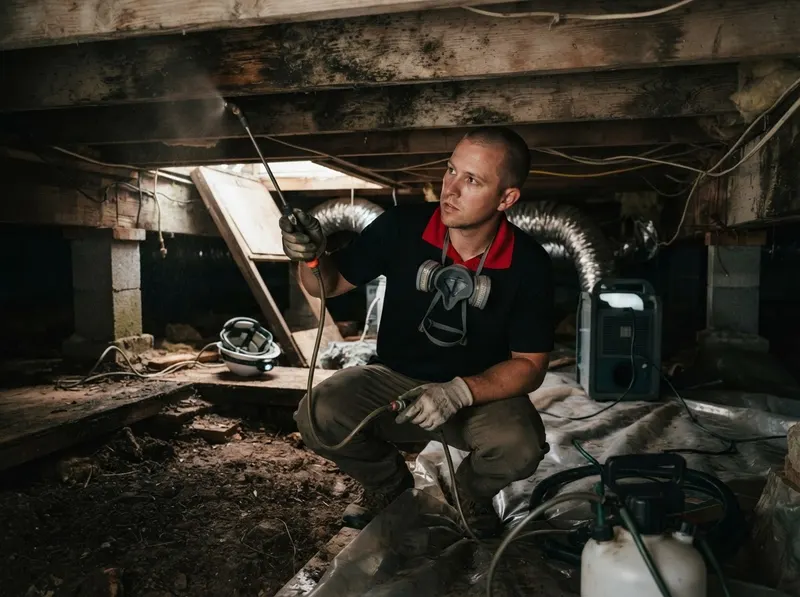
Coastal foundation framing in Charleston County faces relentless ambient humidity, with outdoor dew points routinely exceeding 70 degrees Fahrenheit from April through October. In neighborhoods with historic raised brick piers like South of Broad, Harleston Village, and Radcliffeborough, moisture migrates from tidally influenced shallow water tables straight up into antique heart-pine sill plates. Standard foundation vents pull warm, saturated maritime air into cooler subfloors, where it condenses directly onto structural lumber. When wood moisture equivalent (WME) levels exceed 19%, wood-decaying fungi (Coniophora puteana and Porotheleum species) begin digesting cellulose fibers, creating a chemically primed corridor that attracts eastern subterranean termites and wood-boring powderpost beetles. Remediating subfloor humidity removes the biological moisture reservoir necessary for persistent American roaches (palmetto bugs) to breed and nest beneath interior living quarters.
Controlling this ecosystem requires matching remediation architecture directly to construction typology. For homes situated along tidal creeks in West Ashley and James Island, ground saturation calls for 10-mil to 20-mil cross-laminated ground vapor retarders staked, taped, and sealed directly against piers to stop capillary water transpiration. In slab-adjacent crawlspaces typical of Daniel Island or 1920s craftsman bungalows in Wagener Terrace and Hampton Park Terrace, ambient condensation calls for closed-vent configurations paired with commercial-grade subfloor dehumidifiers pulling 70 to 110 pints of water per day. The trade-off between open-vent passive management and closed crawlspace stabilization comes down to foundation clearance and mechanical installation: closed systems require active electrical hookups and drainage basins, whereas passive treatments eliminate standing condensation without continuous energy consumption, provided subfloor cross-ventilation remains unobstructed.
Homeowners frequently confuse atmospheric mold remediation with structural wood moisture mitigation. Spraying surface bleach or cosmetic biocides removes superficial discoloration on lumber faces, yet fails to penetrate subterranean termite nesting corridors or stop continuous vapor transmission rising through marsh soil. Long-term structural protection follows four methodical stages: 1. Calibrated electrical-resistance pin readings map subfloor moisture gradients across foundation corners. 2. Wood-penetrating disodium octaborate tetrahydrate (DOT) is applied at high pressure, diffusing up to one-half inch into structural timbers to create an active fungicidal and insecticidal barrier. 3. Crawlspace ground soils are leveled, raked clear of organic cellulose debris, and sealed beneath heavy vapor barriers. 4. Dedicated foundation drainage lines or condensation pump routing discharge accumulated water away from foundation footings.
Every job gets a firm, written price after a free on-site visit.
Tell us about your crawlspace mold and wood moisture reduction job in Charleston and we'll send a clear, written quote, usually the same day.
 Coastal Wren Pest Control