Historic architecture in areas like South of Broad and Harleston Village presents distinct physical challenges for bed bug extermination. Plaster lath walls, broad pine floorboards, and hollow masonry cavities provide…
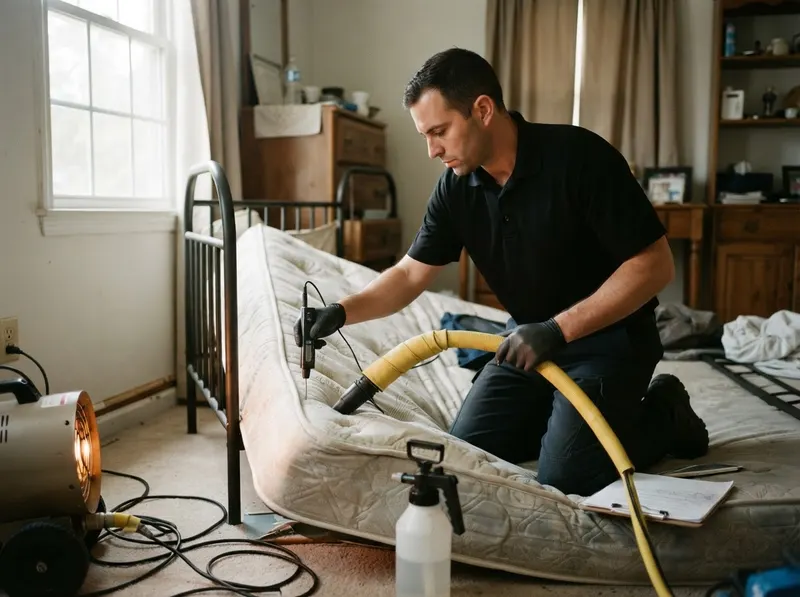
Historic architecture in areas like South of Broad and Harleston Village presents distinct physical challenges for bed bug extermination. Plaster lath walls, broad pine floorboards, and hollow masonry cavities provide deep harborage channels that aerosol contact sprays cannot penetrate. In these environments, single-stage liquid treatments often fail because bed bug eggs resist standard insecticidal contact. A combined protocol solves this vulnerability: specialized forced-air industrial heaters elevate ambient temperatures inside the room to 122°F, 135°F, maintaining that level across a 4-hour hold time to denature all life stages, including heat-resistant egg clusters hidden deep behind trim moulding.
In newer elevated builds or slab properties throughout Daniel Island and West Ashley, mechanical chemical barrier application complements thermal measures. Because coastal humidity slows drying times and ambient air cooling, technicians pair controlled thermal convection with non-repellent residual chemicals around baseboards, electrical outlet housings, and bed frames. This trade-off balances speed and durability: thermal heating delivers immediate structural knock-down without leaving lingering scents, while the residual non-repellent compound intercepts any specimens reintroduced via luggage or visitor traffic across the subsequent 60 to 90 days.
Bed bug remediation follows four sequential operating steps. First, technicians inspect mattress seams, electrical plates, and baseboard joints using high-intensity illumination. Second, heat-sensitive belongings, including candles, pressurized cans, and fine oil paintings common in Radcliffeborough and Hampton Park Terrace properties, are cataloged and isolated. Third, high-temperature directional blowers circulate air to ensure uniform heat penetration into subflooring and framing timber. Fourth, an insect growth regulator (IGR) combined with a microencapsulated residual layer is applied to harborages around foundation piers and interior perimeters, establishing persistent defense across the humid summer turnover season.
Every job gets a firm, written price after a free on-site visit.
Tell us about your bed bug heat and chemical remediation job in Charleston and we'll send a clear, written quote, usually the same day.
 Coastal Wren Pest Control